How Many People Died in Pompeii? The Numbers Explained
Last updated November 2026: how many people died in Pompeii has no single answer, but the best-documented count is about 1,150 identified victims inside the city. NOAA's hazard database record puts the wider total near 1,600. Older estimates say nearly 2,000 deaths for Pompeii and Herculaneum combined.
Featured image: daryl_mitchell, CC BY-SA 2.0, via Flickr.
Short answer: how many people died in Pompeii
Scholars give different totals because each one counts something different. Excavators identified about 1,150 victims inside Pompeii, and the NOAA/NCEI record gives about 1,600 as a wider total. Many authors quote nearly 2,000 deaths for Pompeii and Herculaneum together. Treat that last figure as an estimate, not a body count. For the event itself, read our guide to the 79 AD eruption.
Before reading 1,150 as a share of the city, note that the 15,000 to 20,000 population figure covers both towns.
| Figure | What it counts | Source | Caveat |
|---|---|---|---|
| About 1,150 | Identified victims inside Pompeii | NOAA/NCEI hazard database | Recovered remains only; early excavations kept patchy records |
| About 1,600 | Total victims in the NOAA record | NOAA/NCEI hazard database | Includes victims beyond the 1,150 city count; read the full record for the split |
| Nearly 2,000 | Deaths in Pompeii and Herculaneum combined | Steven Tuck's study, as reported in 2019 | Estimate, not a count of bodies |
| 15,000–20,000 | Residents of both towns | Steven Tuck's study, as reported in 2019 | Combined population, not Pompeii alone |
Why the number varies
No census survives for the morning of the eruption, and no one counted the dead at the time. Every modern figure is a reconstruction from bodies found, plus an estimate of who was never found. Four problems explain most of the gap between 1,150 and 2,000.
- Recovered remains versus estimated deaths: a skeleton in the ash is evidence, while a missing resident is only an inference.
- Pompeii alone versus Pompeii plus Herculaneum: "about 2,000" is often read as one city when it describes two.
- Excavation methods: 18th-century and early 20th-century digs were not recorded to modern standards, so some remains were never catalogued.
- Deaths outside the walls: some people died on the roads or fled and died elsewhere, so they never entered the city count.
Which number should you quote?
Quote about 1,150 when you mean victims identified inside Pompeii. Quote nearly 2,000 only for both towns together, and label it an estimate. Mistake to avoid: giving one tidy figure without saying what it counts. A reader who hears "2,000 died in Pompeii" will picture a city emptied, and the evidence does not support that.
How people died in Pompeii
Deaths came in two phases. First, pumice and small stones called lapilli fell for hours, and roofs began to collapse under the weight. Some residents were crushed indoors, and others were hit while trying to leave. Next, according to Pliny the Younger's letter to Tacitus, a fresh surge of activity came after a pause. Pyroclastic surges are fast clouds of hot gas and ash, and they reached the city on the second morning. NOAA's record attributes 62% of deaths within the city to these surges. Researchers describe the remaining deaths as linked to ashfall and collapse. A deeper explanation of the volcano's behavior sits in our Vesuvius eruption explainer.
How many lived in Pompeii, and how many escaped

Population is the second weak point in every death-toll comparison. Classicist Steven Tuck of Miami University estimates that 15,000 to 20,000 people lived in Pompeii and Herculaneum together. Most of them survived, according to his study in Analecta Romana. Tuck traced refugees by looking for family names and cults distinctive to the two towns. Those names reappear after 79 AD in Cumae, Naples, Ostia and Puteoli. Tuck cautions that his method undercounts survivors, because migrants and enslaved people often had no recorded family name. Several individual cases show how people left.
- Cornelius Fuscus: an inscription in Romania describes him as from the colony of Pompeii, later living in Naples, then serving in the army.
- The Sulpicius family: their financial records were found in a strongbox beside the road, about a mile outside Pompeii, and the family appears to have resettled in Cumae.
- Vettia Sabina: she was buried in a family tomb in Naples, and the tomb carries the Oscan word "have", meaning welcome.
- Emperor Titus: the property of victims without heirs funded building projects in cities that took in refugees.
Pompeii compared with Herculaneum and Oplontis
Herculaneum is the usual source of confusion, because the "nearly 2,000" estimate covers it as well. Pompeii and Herculaneum were buried in different ways and left different kinds of evidence. Counts for each town therefore come from separate excavations. Oplontis is a third Vesuvian site with its own story, which our Oplontis guide covers. When a source gives one total for the region, check which of these places it includes before comparing it with the Pompeii figure.
Timeline of the eruption
Pliny the Younger watched from across the bay and wrote to Tacitus years later. His letter is the main eyewitness source, and a modern translation is easy to find. Dating details vary between scholars, so this sequence stays general. Our page on the last Vesuvius eruption covers later activity.
Surges hit on the second morning, and 62% of city deaths trace to them, so that phase is the one to know.
- Day one, afternoon: a tall column rises from Vesuvius and pumice begins falling on Pompeii.
- Day one, night: lapilli accumulate, roofs give way, and streets become impassable.
- Day two, morning: the fall pauses, then pyroclastic surges sweep through the city.
- Afterward: survivors leave for coastal towns, and Pompeii lies buried for centuries.

What you can see today that relates to the victims
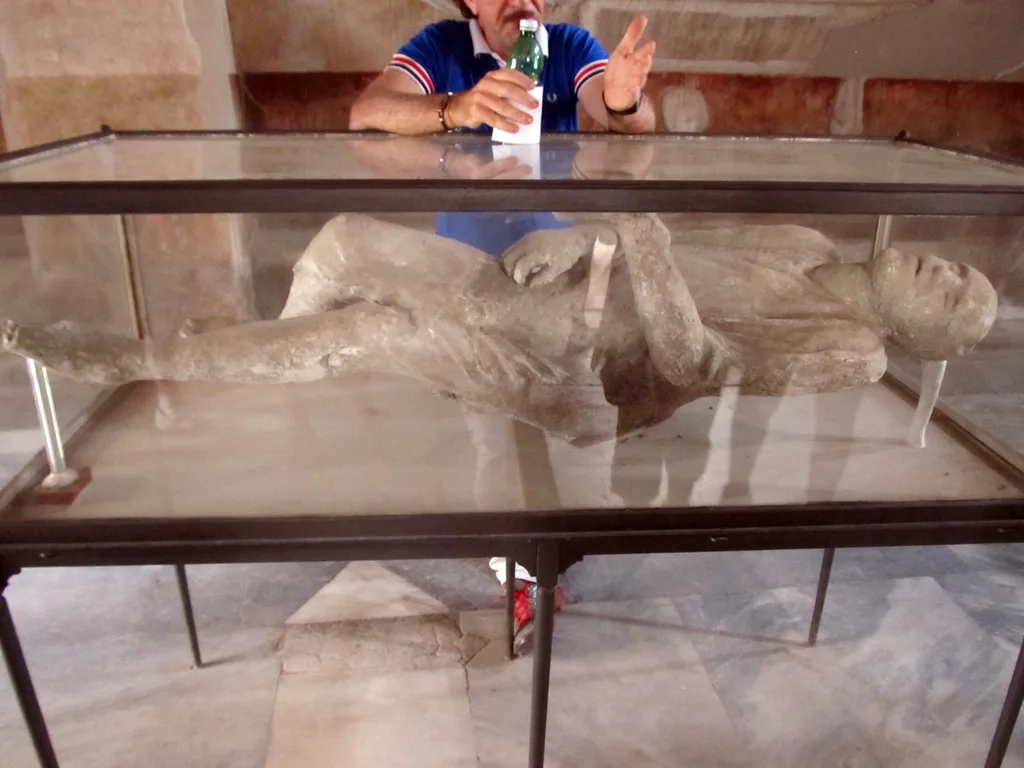
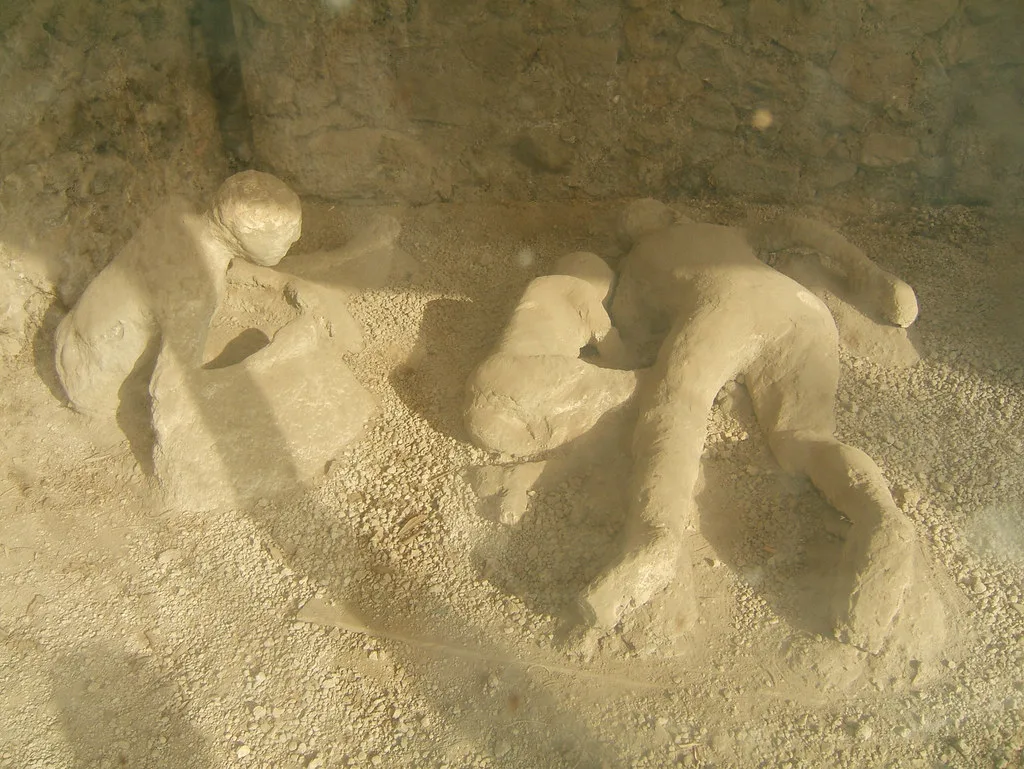
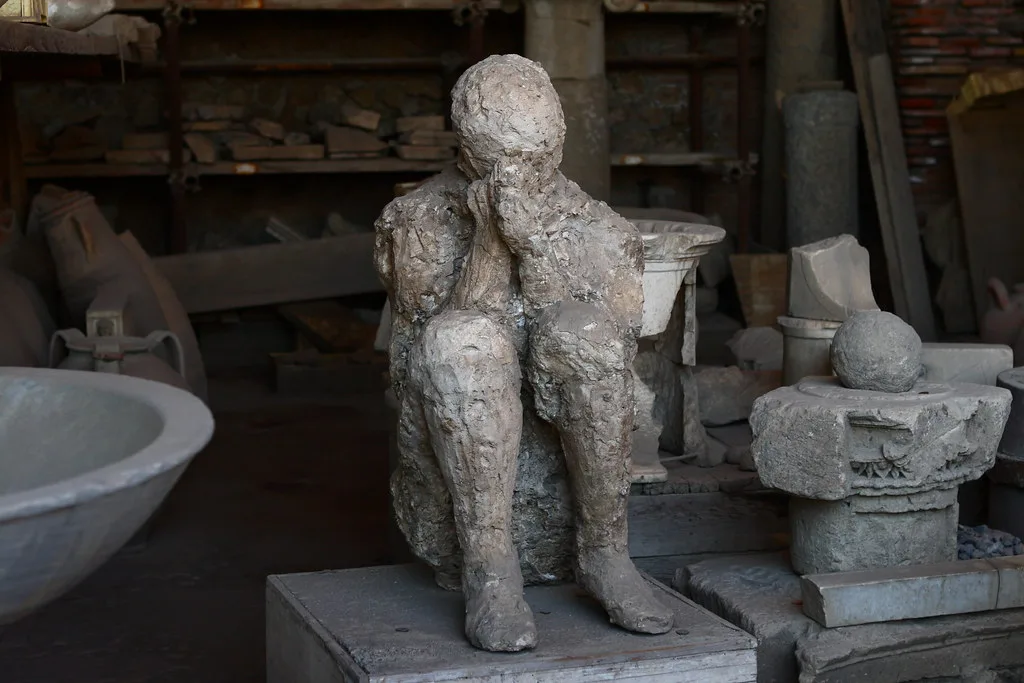
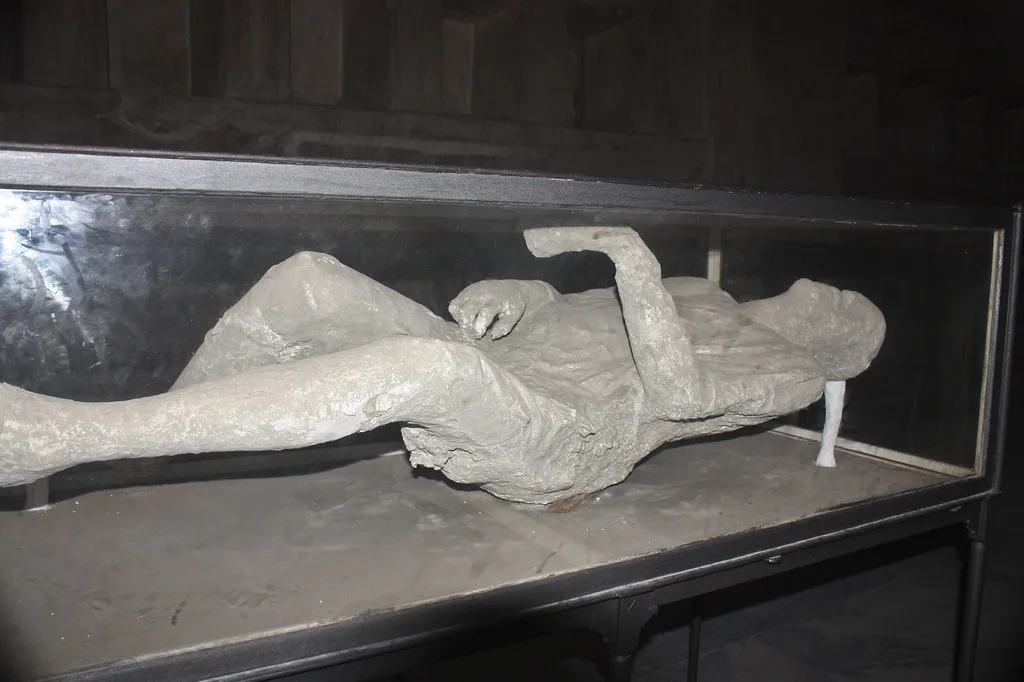
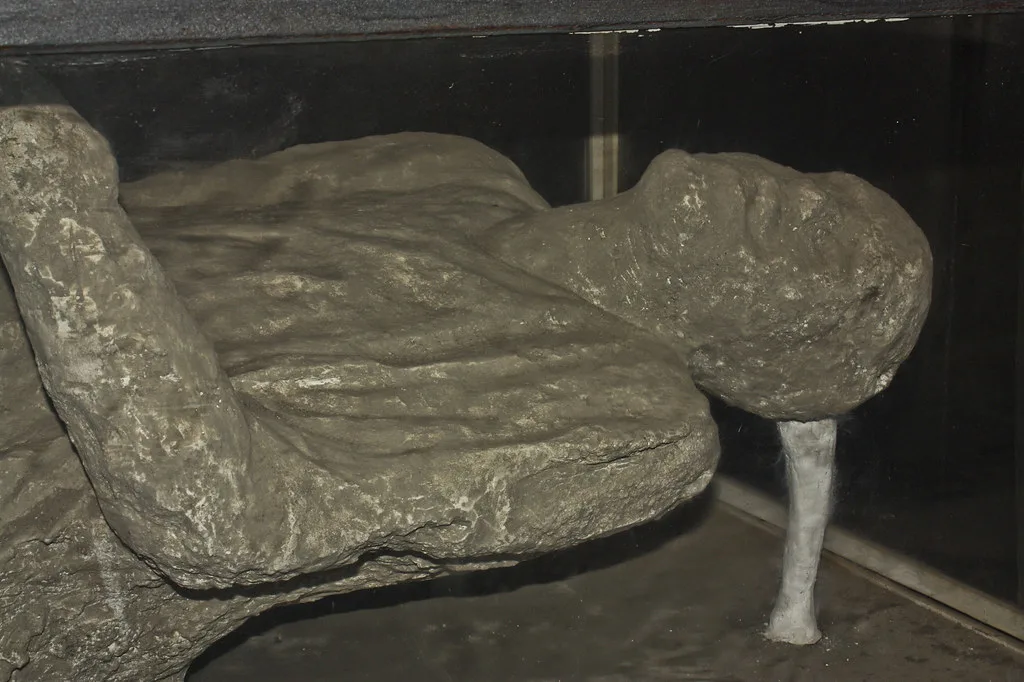
Visitors can see plaster casts made from the cavities that bodies left in the hardened ash. The Garden of the Fugitives is the best-known place for them. Exhibits change, so check the Pompeii Archaeological Park site for what is currently on display. Human remains deserve quiet and respect. Do not touch cases, climb barriers or photograph other visitors' reactions. The Naples museum MANN holds many finds from the site.
How the victims were recovered and recorded
The 1,150 figure comes from bodies and skeletons recovered over more than two centuries of digging, and the methods changed a great deal along the way. Knowing how remains were found explains why the count stays approximate.
Plaster casts
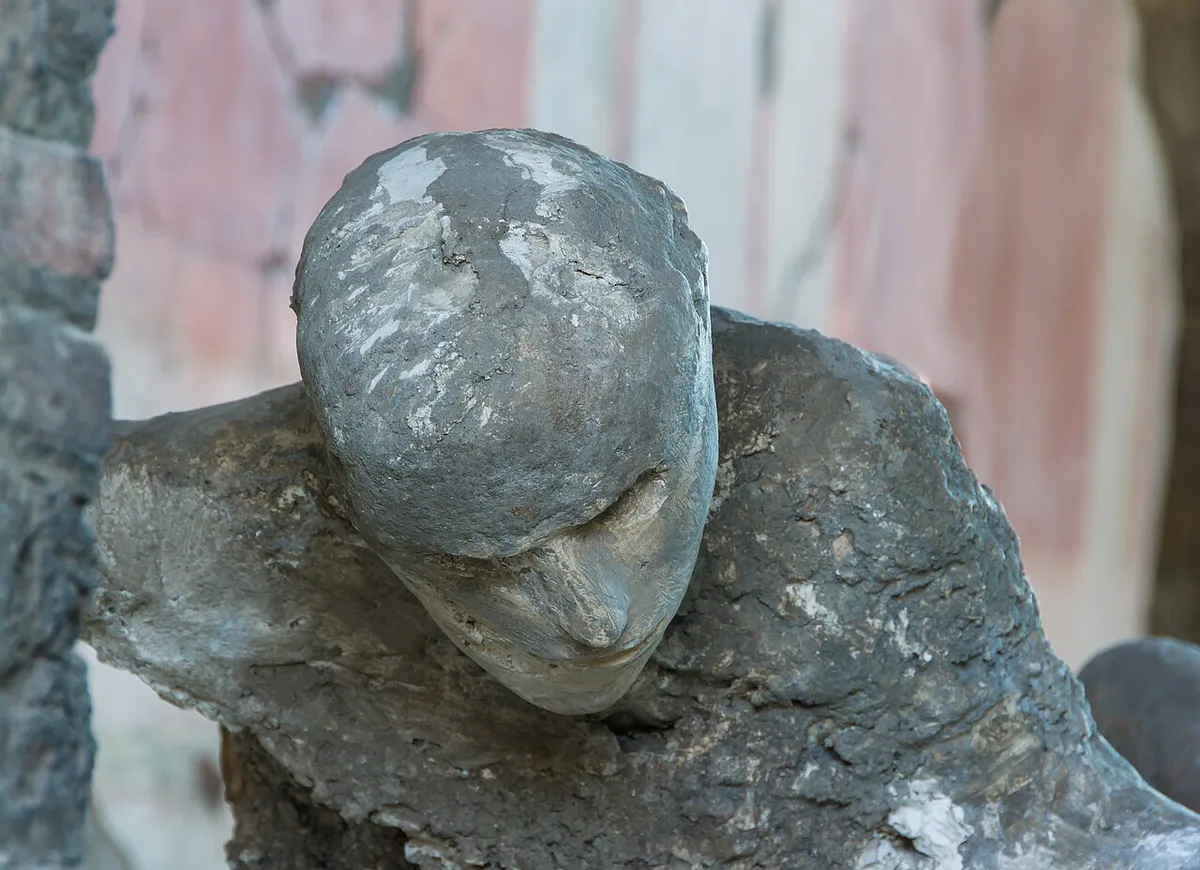
Excavators noticed that the hardened ash contained hollows in the shape of human bodies. The soft tissue had decayed, but the cavity remained. In the 19th century the archaeologist Giuseppe Fiorelli began pouring liquid plaster into these voids. Once it set, the ash was chipped away to reveal a cast of the person's final posture, often with bones and teeth still inside. Roughly 100 casts survive, so they represent only a fraction of the victims.
Where bodies were found
- In the pumice layer, indoors: people who sheltered from the falling stones, many of them crushed by collapsing roofs or trapped behind blocked doors.
- In the ash layer, outdoors: people caught in the streets and gardens when the surges arrived. These are the ones that produced the casts.
- Outside the walls: victims on roads and in nearby villas, who may not appear in a city count.
What modern analysis adds
Researchers now use CT scans, DNA testing and bone analysis on remains and casts. These studies estimate age, sex and health, and in some cases have overturned older assumptions about who was lying beside whom. Because early excavators sometimes discarded or mixed bones, no method can fully reconstruct the original total.
Takeaway: the number of casts on display is not the death toll. It is only a count of the bodies that happened to leave a clean cavity in the ash.
Planning a visit with this context
For logistics, start with getting from Pompeii to Vesuvius. Combined days are covered in our Pompeii and Vesuvius tour guide. Entry options are on the Vesuvius tickets page. Families with young children may want to skip the cast displays or prepare children first. Some visitors also ask whether it could happen again. Read whether Vesuvius is still active and the notes on the Vesuvius Red Zone: What It Is and Visitor Impact.
See our tourism attractions guide for the broader city overview.